What the Real Book got WRONG About Stella By Starlight
I've always loved practicing Stella by Starlight. The changes are so unconventional and so challenging to play over, and I've always had fun throwing on a metronome and trying to sound melodic over that form.
In school, my professors always encouraged me to refer to fake book charts as a resource for learning songs, and like any other diligent music student I bought all the Real Books that I could find to study from. As a reference, here is the changes for Stella by Starlight as published in the Real Book.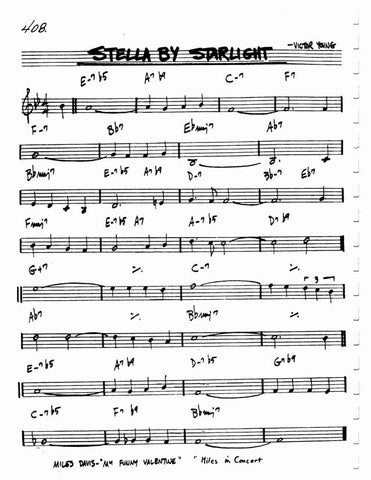
The Problem
As beautiful as these changes are, I was routinely having trouble with the opening three bars. How is it that an A7 should resolve to a Cm7? I'm sure there's a way, I've heard lots of musicians play over this section in very musical ways, and my attitude was that the most likely source of my difficulty with this cadence is a deficiency in my own musical proficiency and that the most reasonable solution was to practice until I could hear my way through it better.
One day while working on these changes, I decided to do some research and find out how some more accomplished musicians were approaching this tune to see if I couldn't fast track my progress a little bit and come at it with a fresh perspective. Well, I certainly did gain some perspective but it turned out to be a little more profound of a learning experience than I had originally anticipated.
Exhibit A
The first resource I found that changed my approach to the opening three bars of this song came from a video I found on YouTube of a workshop taught by guitarist Peter Bernstein in Bologna. I've embedded the video here so that you can see it for yourself.
At the 1:00 mark of this video, Peter Bernstein explains that the first chord of Stella by Starlight is actually a Bb diminished chord. He follows this by urging students to "go on YouTube and look at the movie that that song is from". The movie that he's referring to for which the song Stella by Starlight was written is the 1944 film titled "The Uninvited". I've included a video of the opening of the film here, where you can hear the original arrangement of the song with the original opening chord for yourself.
Exhibit B
The second video that I came across where somebody mentioned this discrepancy between the changes in the Real Book and in the original score is of a clinic taught by Dr. Barry Harris in Spain.
At the 35 minute mark in this video, Dr. Harris mentions that the first chord of Stella by Starlight is actually a Bb diminished major 7. While this may be slightly different from Peter Bernstein's Bb diminished description, if you consider that the melody note is an A it appears that the major 7 that Barry Harris is mentioning is simply accounting for the melody note.
As far as I'm concerned, a consensus between two musicians as accomplished as Peter Bernstein and Barry Harris (not to mention actually listening to the original recording) is enough evidence I need to consider this case to be closed. But what does this mean as far as approaches to improvisation?
Improvisational Implications of the New Changes
One of the first things that I noticed when approaching this song with the original opening chord of Bb diminished rather than the Real Book changes is that the Em7(b5) chord is dropped. Realistically, depending on how you think about A7 in this context that could be the only real difference. That is to say that thinking of an A7 chord as Bb diminished really isn't anything unusual, although if you've never tried playing Bb diminished over the A7 chord before, it really is so much easier to resolve to Cm7 than some of the things that I know I sometimes reach for when I think I'm playing over a II V progression.
That said, thinking of this opening two bars as a Bb diminished chord resolving to Cm7 opens up some avenues that may have been left otherwise unexplored. One of my favourite approaches to take over a diminished chord is to take the four related dominant chords (in this case A7, C7, Eb7, and F#7) and play lines that run them into each other. For example, I might play eight notes of the C lydian dominant mode descending from C (C, Bb, A, G, F#, E, D, C) and then continue by playing eight notes descending down the Eb lydian dominant mode from where I left off (Bb, A, G, F, Eb, Db, C, Bb) and then resolve to C over the Cm7 chord. If this idea is new to you, I go into greater detail about it in a blog post I wrote called Keeping It In The Family that you can check out.
Cultural Implications of the New Changes
While it is very cool that I was able to come across the original changes in the opening few bars of this tune and it gave me a new approach to improvisation, I am a little bit concerned about the cultural implications of the discrepancy between the original changes and those found in the Real Book.
In both the videos with Peter Bernstein and Barry Harris, each musician referred back to the original recording from the film as though it is common sense to compare the changes in the Real Book to the ones from the film. In the video with Barry Harris at the 44 minute mark, he describes how he used to go about learning standards. He says he used to go to the library and ask for the "tune dex file" which was a 3 x 5 index card that contained all the essential elements of popular songs including the changes, melody, composer and published.
I know that when I studied jazz in university, not one of my professors suggested that I should look up the actual changes for any standard either by going to the library or by referring back to the original recording. I'm not sure if this is because they didn't carry out this practice themselves or if they were just too busy or perhaps didn't think to pass this information down to their students, but what I am sure of is that most of the musicians I know accept the changes presented in the Real Book as the gospel truth.
If you've never owned a copy of the Real Book, they are really helpful tools for learning songs and they're great to have on a gig if your repertoire isn't that big and people will be calling tunes.
E book versions are available and very useful, like this one here
but paperback versions are of course still available as well.
Given the improvisational nature of jazz music and the malleability of harmony in that sort of context, perhaps it isn't detrimental to have a deviation between the original changes of a song and those in the Real Book chart. It is true that many musicians have a deep enough understanding of harmony that they are not tethered to the changes as they appear on the page regardless of the accuracy, but maybe future generations are playing a game of broken telephone with a largely aural tradition that is becoming increasingly watered down. Let me know what you think by commenting on this post if you feel so inclined, and thank you for checking out my thoughts on this subject!
11 comments
Something to consider here is that the Miles Davis version seems to align with those real book changes. It seems to me that people tend to use the changes from Miles Davis versions of tunes. The real book sheet even references Miles’ recording on the bottom of the page. For example, if I’m remembering correctly, Stablemates begins with a Bb7alt for one bar, followed by a 2-5-1 in Db, but the Miles Davis version starts with E-7 to A7 in one bar, followed by the 2-5-1, and it seems to me that everyone plays the Miles Davis version. Just a thought :)
Thanks for this post! I really should have dug out the original a long time ago. The Real Book changes always sounded plonked-on-top in an awkward way to me, and this post has made me study it properly. There’s a bunch of inversions in the original that make the chords make way more sense. I note, too, that the A♭7 in bar 21 is really an E♭–∆, which clarifies the colour of that bar. Nice!
NB you often hear that Miles was responsible for the modern changes, but the II V changes for Stella were recorded before Miles Davis’s famous recording (such as on Jim Hall’s debut record), so have clearly been popular with jazz players for a long time. Parker’s version OTOH has the diminished (on With Strings).
Modally, Parker seems to be hearing it as belonging to the IIIm of the key (Dm in Bb) and playing D harmonic minor, which actually matches up with the Real Book changes. So the two options are not so different.
We don’t have to play the Songbook changes, but it brings a richer understanding of the song if we check out the songbook, original non-jazz recordings of the song, as well as listening through its recorded history. It has never been easier to do that.
NB you often hear that Miles was responsible for ht modern changes, but the II V changes for Stella were recorded before Miles Davis’s famous recording (such as on Jim Hall’s debut record), so have clearly been popular with jazz players for a long time. Parker’s version OTOH has the diminished (on With Strings).
Modally, Parker seems to be hearing it as belonging to the IIIm of the key (Dm in Bb) and playing D harmonic minor, which actually matches up with the Real Book changes. So the two options are not so different.
We don’t have to play the Songbook changes, but it brings a richer understanding of the song if we check out the songbook, original non-jazz recordings of the song, as well as listening through its recorded history. It has never been easier to do that.
One nice solution is to play the first movement as Dm6/dim, starting on “ off “ (diminished) chord as per BH lingo, then the KEY movements for the A are Dm, Bb, Eb, Eb minor…Key or relative minor of V, I, IV, IVm…this Dm6/diminished allows for diatonic correctness of both the Bb dim AND the modern changes